ZeroDrift™
Introducing ZeroDrift™ Transfer - From CAD to Articulator
The only digital-to-analog transfer protocol with ±0.02mm repeatability on any articulator, even with implant analogs. Patent pending.

Dental Technician Inventor & Founder
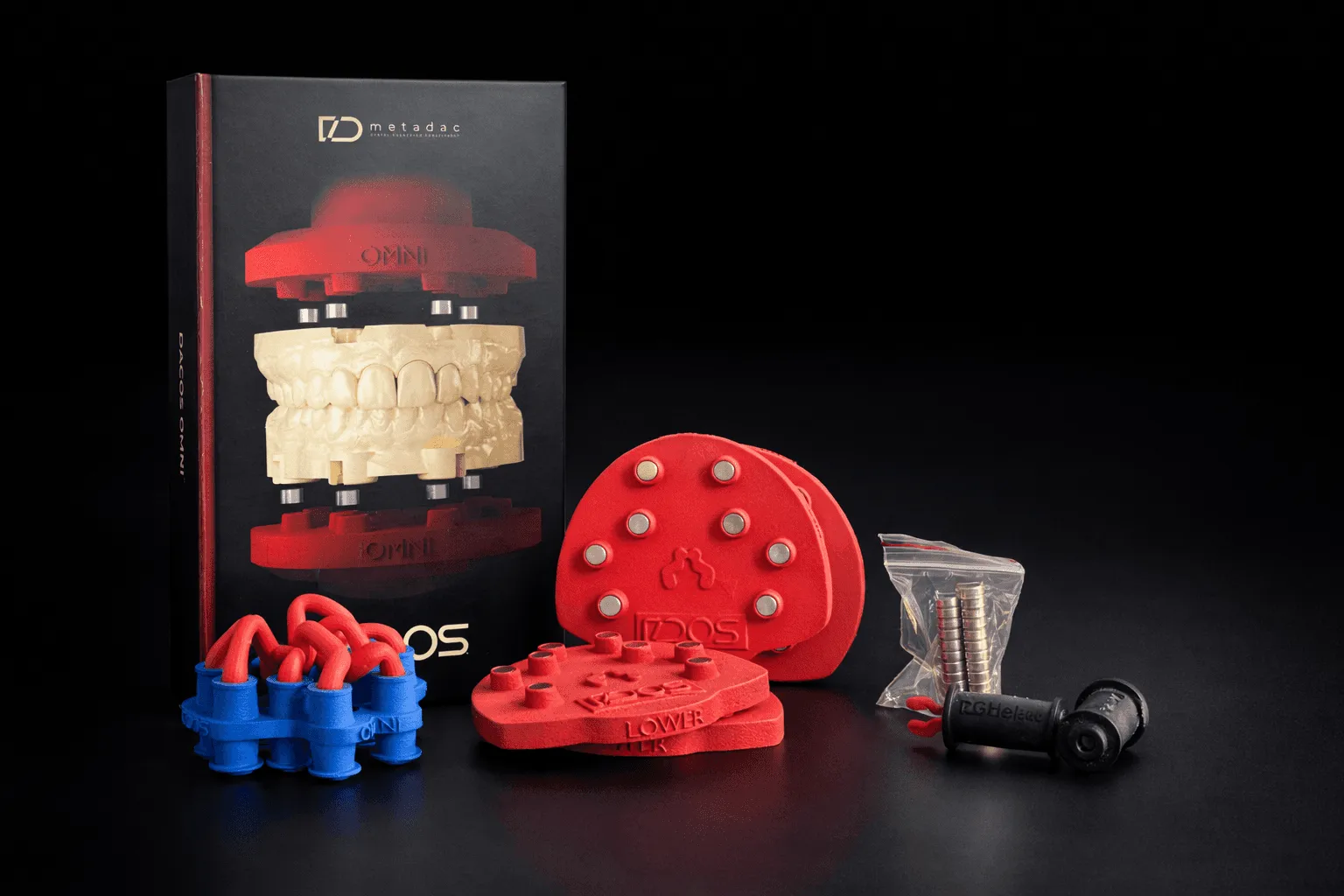
Not Plaster-Free. Transfer Fidelity.
DACOS Omni is not a plaster-free system.
It is a Transfer Fidelity System — a complete protocol of hardware, proprietary CAD libraries, and calibration methodology that guarantees the contacts you design in CAD are the exact same contacts you verify on the articulator.
While every competitor fights the commodity war of who can eliminate plaster faster, cheaper, simpler, DACOS Omni solves the problem after the problem: the silent drift between digital design and physical verification.
Every existing plaster-free solution promises speed and convenience. None addresses what happens in the critical handoff from digital to analog. Bulky bases that shift reference points. Geometries so oversized they force 45° print orientation — increasing print time and compromising tooth quality. Bases that physically intersect with implant analogs, making complex cases impossible. No calibration to account for printer or articulator variability.
You’re eliminating plaster, yes. But you’re replacing it with a new, invisible source of imprecision.
DACOS Omni with ZeroDrift™ Transfer is the first system engineered to preserve transfer fidelity — guaranteeing that what you verify on the articulator is mathematically identical to what you designed in CAD. Because precision in digital means nothing if you lose it in the transfer to analog.
The Four Pillars of ZeroDrift™
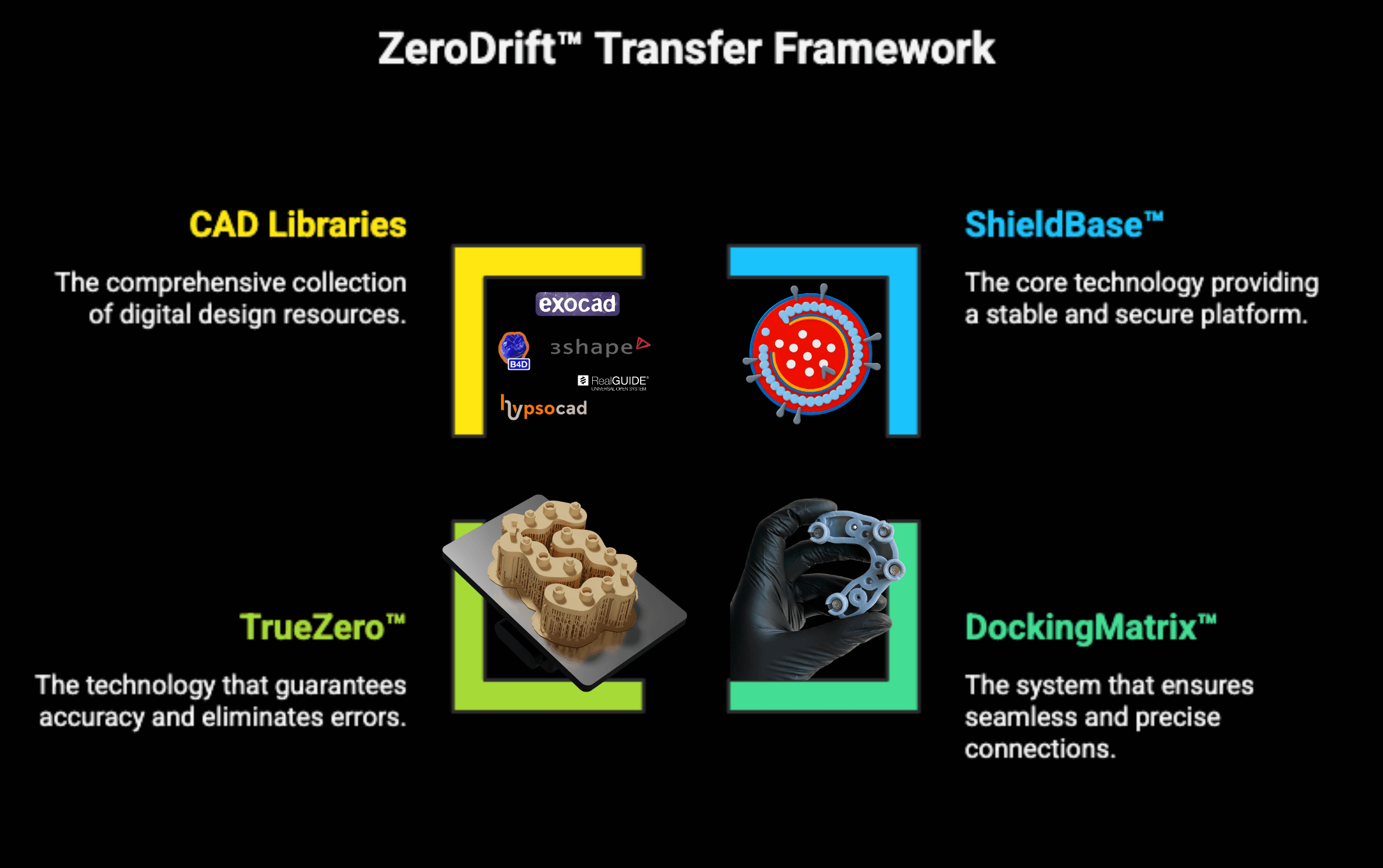
ZeroDrift™ Transfer is not a feature. It is not a component. It is a complete protocol built on four proprietary, inseparable pillars. Each pillar is individually protected by patent or design registration. Together, they create a defensible, unreplicable system that no competitor can copy.
Pillar 1: ShieldBase™ Geometry ⚡ Patent Pending
ShieldBase™ is the only print geometry in the dental laboratory market engineered from scratch specifically for 3D printing. It features a protected contact zone that isolates the articulator interface from deformation during printing. Dedicated geometry that can be printed without supports, and a two-step blind seat cavity (mouth + bore) with a ≤0.7mm peripheral lip for support-free printing.
The geometry includes a stand-off rim that prevents base-to-base contact during articulation, and three XY-tolerance variants (tight/standard/loose) differing by 0.07–0.15mm to compensate for printer-specific shrinkage characteristics.
No competitor offers a geometry optimized for additive manufacturing. They all use legacy base geometries adapted from plaster-casting workflows — bulky, oversized, requiring 45° print orientation to minimize supports. With ShieldBase™, you print flat with supports or directly to the base, with no compromise on precision or throughput. Your teeth print horizontally, where resin curing dynamics produce the best surface quality. The base geometry works for you, not against you.
Pillar 2: DockingMatrix™ Configuration ⚡ Patent Pending
DockingMatrix™ is the modular magnet architecture that makes implant cases as easy as single-unit cases.
The physical mounting plate features 8 magnets arranged in strategic positions. Each printed model uses 4 of those 8, selected from 4 different attachment types, yielding 9 possible combinations. This modular configuration allows you to choose magnet positions that avoid interference with implant analogs, no matter how complex the case.
Every other plaster-free system uses oversized bases that physically intersect with analog positions. The base itself becomes the problem — not the magnets. DockingMatrix™’s compact footprint and configurable positions eliminate that conflict entirely. Full-arch cases with multiple implant analogs? You select the attachment pattern that clears every analog. The system adapts to the case, not the other way around.
Pillar 3: TrueZero™ Calibration ⚡ Patent Pending
ShieldBase™ is the only print geometry in the dental laboratory market engineered from scratch specifically for 3D printing. It features a protected contact zone that isolates the articulator interface from deformation during printing, and a compact horizontal extension that can be printed without supports.
The geometry includes a stand-off rim that prevents base-to-base contact during articulation, and three tolerance variants (tight/standard/loose) to compensate for printer-specific shrinkage characteristics.
No competitor offers a geometry optimized for additive manufacturing. They all use legacy base geometries adapted from plaster-casting workflows — bulky, oversized, requiring 45° print orientation to minimize supports. With ShieldBase™, you print flat with supports or directly to the base, with no compromise on precision or throughput. Your teeth print horizontally, where resin curing dynamics produce the best surface quality. The base geometry works for you, not against you.
Pillar 4: Dedicated CAD Libraries
ZeroDrift™ lives inside the workflow you already use. Dedicated CAD libraries are available for exocad, 3Shape, and Blender for Dental, with all 4 attachment types and 9 combinations pre-integrated into the design environment.
The CAD plugin applies attachment patterns via Boolean operations — you select the configuration appropriate for your case, and the system automatically integrates the geometry into your design. No external tools. No manual adjustments. No guessing. The protocol becomes part of your CAD workflow, not something you do afterward.
The Measurable Promise: TrueContact™ Guarantee
Within ZeroDrift™ Transfer lives the TrueContact™ Guarantee — the measurable promise that the contacts established in CAD are the exact same contacts verified on the articulator, within ±0.02mm tolerance.
This is not a marketing claim. It is a metrology specification.
When you calibrate with TrueZero™, mount with DockingMatrix™, and design with ShieldBase™ geometry, you achieve repeatable dimensional fidelity across multiple remount cycles, on the same articulator, with the same model, measured with a calibrated gauge. Remove the model. Remount it. Measure again. ±0.02mm. Every time.
No competitor publishes a repeatability specification. They talk about “precision” and “accuracy” in abstract terms. They cannot guarantee a number because they have not engineered a protocol that produces one. Their systems eliminate plaster but introduce uncontrolled variables — oversized bases, forced print orientations, no calibration, no modular configuration.
TrueContact™ elevates DACOS Omni from a product to a certified protocol. You don’t buy a kit. You adopt a protocol with a measurable guarantee. The contacts you design in CAD are the contacts you verify on the articulator. Not approximately. Not usually. Always. Within ±0.02mm. That is the standard. That is TrueContact™.
What This Means For Your Lab
Specifications matter when they translate into daily impact. Here is what ZeroDrift™ Transfer changes in your workflow:
5-minute remounting instead of 30. Traditional plaster-to-articulator mounting requires mixing, setting, cleanup, and verification. With ZeroDrift™, you print the model with integrated ShieldBase™ geometry, select the DockingMatrix™ configuration in CAD, and mount magnetically in under 5 minutes. 25 minutes saved per case. On 10 cases per day: 4+ hours returned to production daily. In a year: over 1,000 hours reclaimed.
Universal compatibility with any articulator. Artex, SAM, and every traditional articulator. No proprietary ecosystem. No vendor lock-in. You use the articulator you already own. The system adapts to your bench, not the other way around.
Full implant analog freedom on every case type. DockingMatrix™’s 9 attachment combinations mean you never face the choice between accuracy and analog placement. Full-arch implant cases? Multi-unit bridges with analogs? Complex removable prosthetics? Select the magnet configuration that clears every analog. The system handles it.
Elimination of bench adjustments caused by transfer error. When the pin doesn’t return to zero after remounting, you lose time troubleshooting. Is it the scan? The print? The articulator? The mount? With ZeroDrift™ and TrueZero™ Calibration, you eliminate the question. If you followed the protocol, you know with mathematical certainty that those contacts are exactly what you designed. ±0.02mm. The doubt is over.
Mathematical confidence that cases only come back for the definitive. A full-arch case that returns for incorrect contacts costs time, materials, credibility with the practice, and team morale. With ZeroDrift™, when the case leaves the lab, you know it’s right. You verified it against the protocol. The contacts match CAD. The workflow is certified. Cases come back for delivery, not corrections.
Protected by International Patent
The DACOS Omni system is protected by pending international patent applications covering the adapter system, calibration method, attachment geometry, and magnet placement technology. The ShieldBase™ geometry is additionally protected by Hague design registration.
This matters because it means the system cannot be cheaply copied.
No competitor can replicate ZeroDrift™ Transfer by copying one component. It is not the magnets alone. It is not the geometry alone. It is not the calibration alone. It is the synergistic interaction of all four pillars working together as a unified protocol. Copying one piece without the others does not produce the same result.
When you adopt DACOS Omni with ZeroDrift™ Transfer, you adopt a protocol that cannot be commoditized. You invest in a system engineered to last, legally protected, and technically unreplicable.
From CAD to Articulator. Losing Nothing.
The promise of digital dentistry was total control — from scan to design to fabrication. But at the most critical moment, the transfer from digital to analog, every existing system introduces error. Silent drift. Uncontrolled variables. Compromises disguised as convenience.
DACOS Omni with ZeroDrift™ Transfer is the missing link that completes the digital chain. ShieldBase™ Geometry preserves dimensional integrity through the print process. DockingMatrix™ Configuration adapts to every case complexity. TrueZero™ Calibration compensates for every system variable. Dedicated CAD Libraries integrate the protocol into the tools you already use.
The result: ±0.02mm repeatability. 5 minutes per remount. Universal articulator compatibility. Full implant analog freedom. TrueContact™ Guarantee.
Zero drift. Zero compromises. Zero cases coming back.
See how labs verify it →
Find your kit →
The DACOS Omni system, including its adapter plates, calibration method, attachment geometry, and magnet placement tools, is protected by pending international patent application PCT.
Next reads
Transfer Drift — The Error Nobody Talks About →
DockingMatrix™ — 9 Combinations. Zero Analog Interference. →