3SHAPE DENTAL SYSTEM

DACOS Omni now lives inside 3Shape.

DACOS Omni now lives inside 3Shape.

One .dme file. Import it once into your Articulator Interface and generate DACOS-ready models directly in Model Builder with the same offsets, the same 9 combinations, and the same ZeroDrift™ Transfer protocol you already trust.

One .dme file. Import it once into your Articulator Interface and generate DACOS-ready models directly in Model Builder with the same offsets, the same 9 combinations, and the same ZeroDrift™ Transfer protocol you already trust.

One .dme file. Import it once into your Articulator Interface and generate DACOS-ready models directly in Model Builder with the same offsets, the same 9 combinations, and the same ZeroDrift™ Transfer protocol you already trust.

Native Articulator Interface · Light & Ultra · Tight / Standard / Loose · 9 combinations + Frame

Generate DACOS-ready models directly inside 3Shape Model Builder.

Generate DACOS-ready models directly inside 3Shape Model Builder.

Generate DACOS-ready models directly inside 3Shape Model Builder.

Your CAD software shouldn’t decide how precise your transfer is.

You already work in Dental System. You already trust Model Builder. What you were missing was a way to bring the DACOS protocol inside it — without exporting to a third-party tool, without rebuilding the base by hand, without hoping the attachment ends up where it should.

That’s what this library does. It puts DACOS Omni where your workflow already is.

The contacts you design are the contacts you verify. Even in 3Shape.

One file. The complete system.

Everything in a single import

A .dme is a container. Both tiers, all three offsets, all nine combinations and the Frame variant live inside one file. You import once. You never chase a second download.

Your offset, not a generic one

Tight, Standard and Loose. Calibrate your printer once with the Gemini Calibrator, then select the matching offset in Dental System. The library adapts to your resin, your exposure, your shrinkage — not the other way round.

DockingMatrix™, natively selectable

All nine attachment combinations, plus the Frame version for short arches and reduced bases. Choose the configuration that clears your analogs and your dies, straight from the Articulator Settings dropdown.

Four steps. Then it’s just your normal workflow.

1

Import the library

Open 3Shape Control Panel, go to Tools → Import/Export, and import the .dme. Once. It stays there.

Importing the DACOS Omni articulator interface library into 3Shape Dental System Control Panel
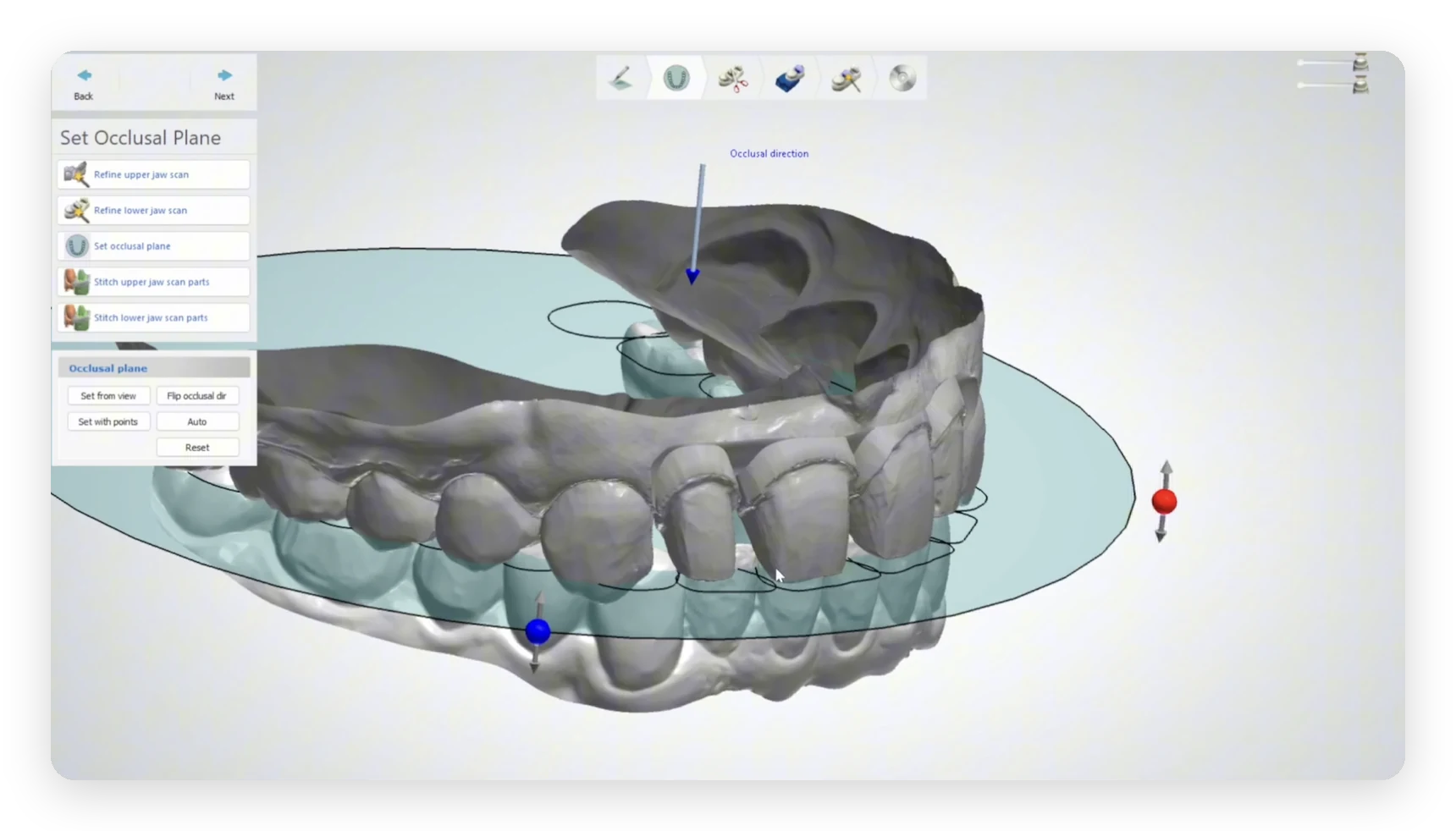
Setting the occlusal plane on upper and lower models in 3Shape Model Builder

2

Orient the models

In Model Builder, place the models on the correct occlusal plane orientation. This is the reference the whole system inherits — get this right and everything downstream follows.

3

Select your DACOS Omni attachment

Pick your tier (Light or Ultra), your calibrated offset (Tight / Standard / Loose), and the combination that clears your case. In 3Shape all three live in one name — DACOS Standard 4-6 Ultra is the Standard offset, combination 6, Ultra tier.

Leave the attachment where the software places it — it inherits the occlusal reference from your model orientation. If you ever lose control of a placement, hit Reset and start that step again.
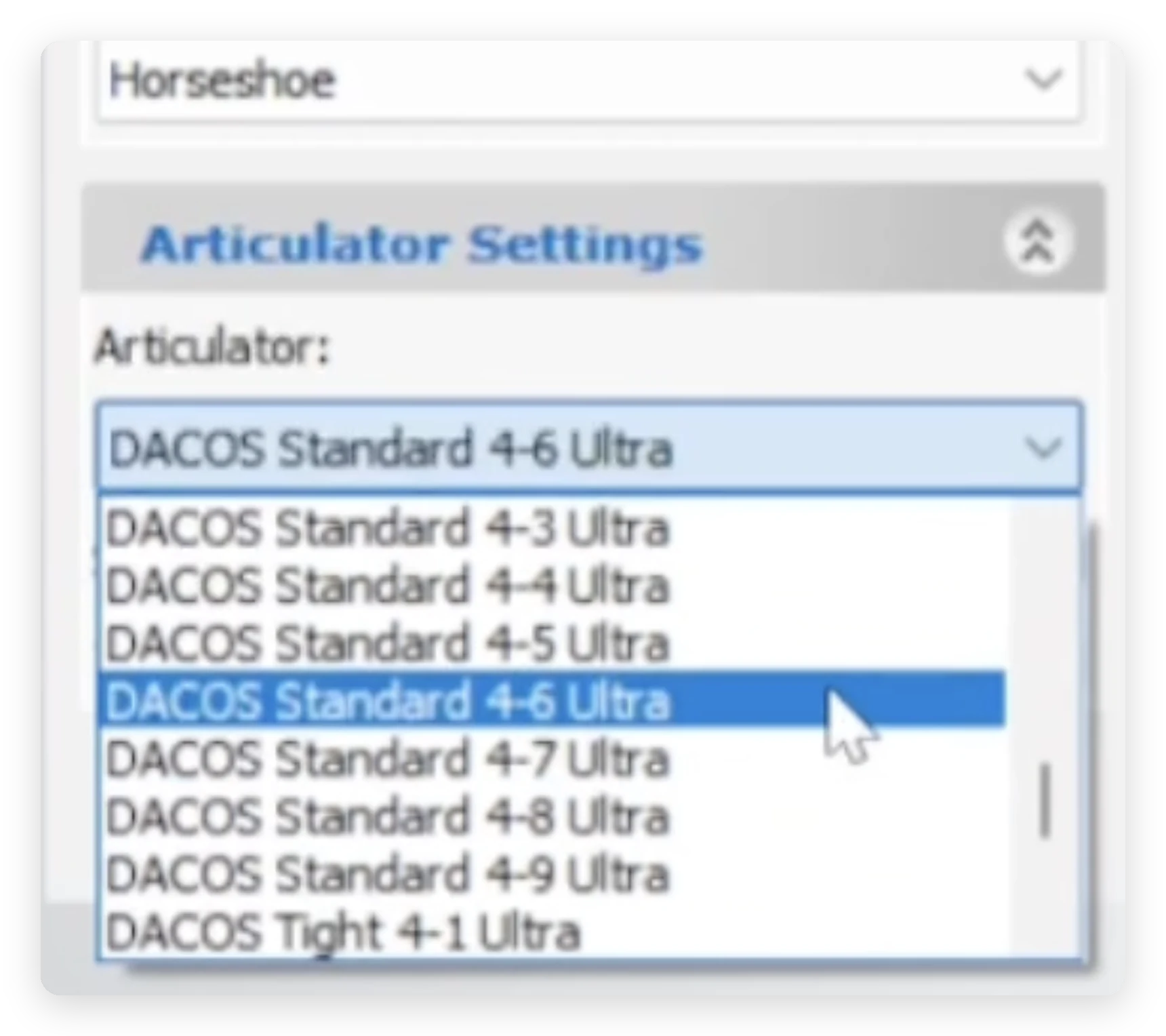
Selecting a DACOS articulator interface from the Articulator Settings dropdown in 3Shape
Finished model in 3Shape Model Builder with the DACOS Omni attachment merged into the base

4

Generate and print

Model Builder merges the attachment into the model. Export, print, snap onto your DACOS plate. Done.

Hollow inside. Solid underneath.

Models generated with the DACOS library are hollowed internally, and the base stays closed at the bottom. That’s intentional. A closed base is a rigid base: less flex during printing, less flex during handling, and a more dimensionally stable seat against the plate — which is exactly what you want from the component whose job is to not introduce error.

Print it as it comes out of Model Builder and you’re finished.

Prefer an open base?

Some labs like to drain and save resin. Open it in your slicer with a simple Boolean subtraction — a cylinder in Chitubox, Meshmixer or your tool of choice, straight through the underside. Two clicks, and the seating geometry is untouched.
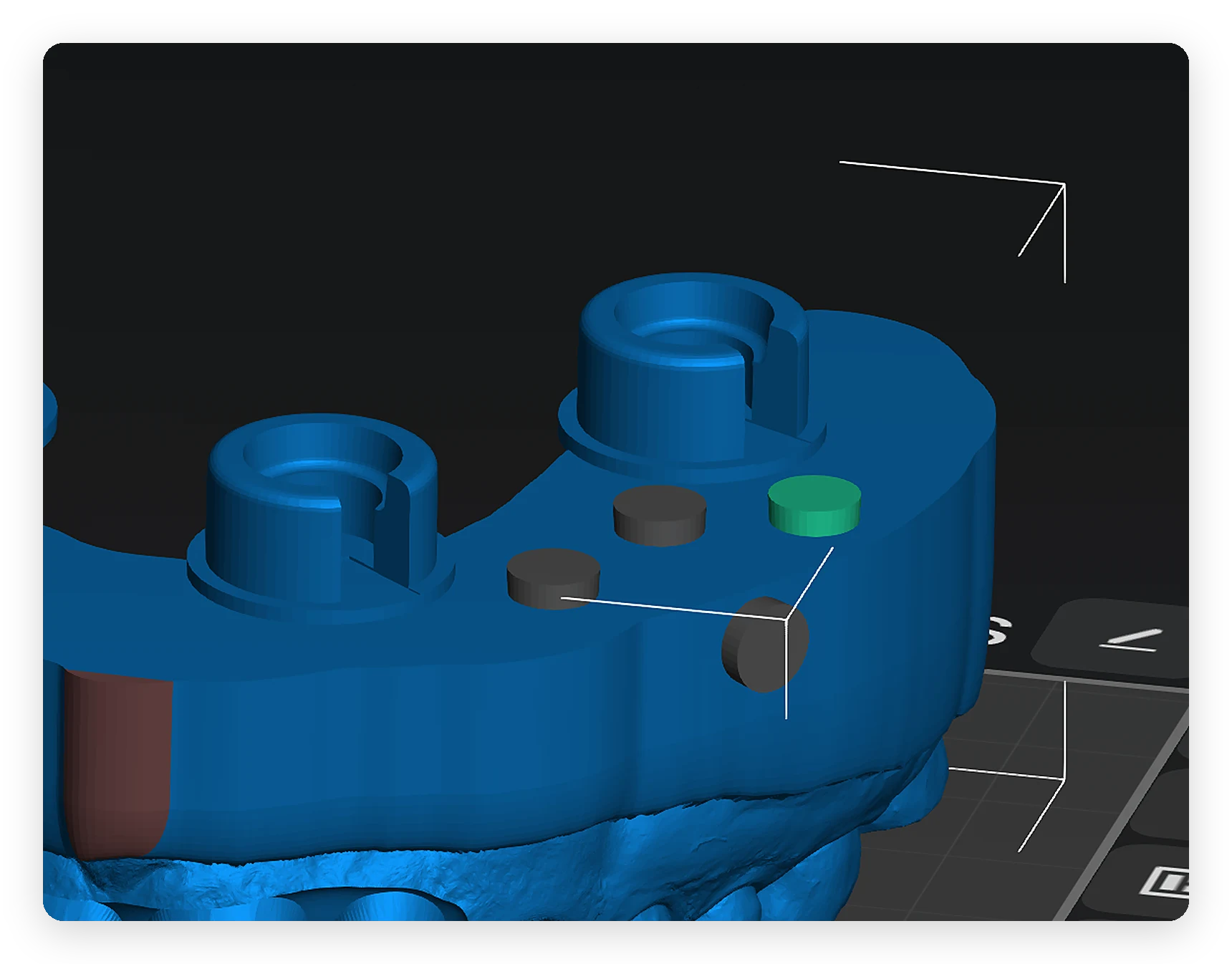
Boolean subtraction cylinders positioned on the closed model base to open it in the slicer

Optional — cylinders positioned between the magnet housings, subtracted in the slicer to open the base.

The transfer is no longer a variable.

Every plaster-free system eliminates plaster. Very few ask what replaces it. Bulky bases that intersect with implant analogs. Base geometries so large they force 45° print orientation — longer prints, worse teeth. No way to account for your own printer’s behaviour.

DACOS Omni is a Transfer Fidelity System. The four pillars — ShieldBase™ Geometry, DockingMatrix™ Configuration, TrueZero™ Calibration and dedicated CAD libraries — exist so that one specific step in your chain, the handoff from CAD to articulator, adds nothing.

Your scan, your printer, your resin, your articulator: those are yours. The transfer is ours. Now it’s ours inside Dental System too.

Internal testing with a calibrated digital indicator measured a system precision ceiling of ±0.02 mm — the maximum repeatability the hardware delivers when every workflow variable is controlled. It proves the transfer doesn’t cause the error. No competitor publishes repeatability data for this step at all.

±0.02 mm is the system precision ceiling under controlled conditions, not a per-case accuracy promise. Real-world results depend on the full precision chain — scan, CAD, print, resin, cure and articulator.

Read: The Precision Chain — what actually determines your result →

Technical specifications

Software

3Shape Dental System

Module

Model Builder — Articulator Settings

File format

.dme (single container)

Library architecture

Static — pre-built attachment geometry merged into the model

Tiers included

DACOS Omni Light · DACOS Omni Ultra

Offsets included

Tight · Standard · Loose

Combinations

4-1 … 4-9 + Frame, per tier and per offset — listed in 3Shape as DACOS <offset> 4-<n> <tier>

Calibration

Gemini Calibrator — offset must match the library offset selected

Model output

Hollowed internally, closed base

Distribution

Direct download

IP

Patent pending · Hague-registered geometry

Wherever you design, DACOS is already there.

Dedicated module. Unlimited attachment combinations, one-click finalization.

Dynamic library. Full Boolean workflow, plate optional, plateless fully supported.

3Shape

This page. Native Articulator Interface library.

Static library.

Frequently asked questions

Do I need a separate file for Light and Ultra?

No. One .dme contains both tiers, all three offsets, all nine combinations and the Frame variant.

Do I need a separate file for Light and Ultra?

No. One .dme contains both tiers, all three offsets, all nine combinations and the Frame variant.

Which offset should I choose?

The one you validated with the Gemini Calibrator on your own printer and resin. The library offset and the calibrator offset must always match — mixing them causes seating errors.

Which offset should I choose?

The one you validated with the Gemini Calibrator on your own printer and resin. The library offset and the calibrator offset must always match — mixing them causes seating errors.

Can I use it with implant analogs?

That’s exactly what the nine combinations are for. Each combination uses a different set of four magnet positions out of the eight on the plate, so you can pick the one that clears your analogs and removable dies.

Can I use it with implant analogs?

That’s exactly what the nine combinations are for. Each combination uses a different set of four magnet positions out of the eight on the plate, so you can pick the one that clears your analogs and removable dies.

What is the Frame version?

An attachment configuration where the sockets are joined by a reinforcement frame — the DACOS Lock. It adds stability on quadrant cases, short arches and reduced bases.

What is the Frame version?

An attachment configuration where the sockets are joined by a reinforcement frame — the DACOS Lock. It adds stability on quadrant cases, short arches and reduced bases.

Should I move or rotate the attachment after placing it?

No. The attachment inherits its reference from your model’s occlusal plane orientation. Leave it where the software places it. If a placement goes wrong, use Reset.

Should I move or rotate the attachment after placing it?

No. The attachment inherits its reference from your model’s occlusal plane orientation. Leave it where the software places it. If a placement goes wrong, use Reset.

The model came out with a closed base — is that correct?

Yes. Models are hollowed inside with the base closed at the bottom, which makes them more rigid and more stable. Print as-is, or open the base in your slicer with a Boolean cylinder subtraction if you prefer.

The model came out with a closed base — is that correct?

Yes. Models are hollowed inside with the base closed at the bottom, which makes them more rigid and more stable. Print as-is, or open the base in your slicer with a Boolean cylinder subtraction if you prefer.

Does it work with my articulator?

DACOS Omni is articulator-agnostic. Artex, SAM, Asa and traditional articulators are supported.

Does it work with my articulator?

DACOS Omni is articulator-agnostic. Artex, SAM, Asa and traditional articulators are supported.

Is it free?

The 3Shape library is included with your DACOS Omni kit. For standalone access or licensing options, contact hello@dacos.dental.

Is it free?

The 3Shape library is included with your DACOS Omni kit. For standalone access or licensing options, contact hello@dacos.dental.

Install it once. Stop thinking about the transfer.

Install it once. Stop thinking about the transfer.

Download the DACOS Omni library for 3Shape, import it into your Articulator Interface, and generate your first DACOS-ready model today.

The DACOS Omni system, including its adapter plates, calibration method, attachment geometry and magnet placement tools, is protected by a pending international patent application.

Get the kit-choice guide

How labs kill transfer drift — straight to your inbox.

© 2026 Metadac FZE. DACOS and the DACOS Logo are trademarks of Metadac.
DACOS Tech is under PCT Patent Pending.
All rights reserved.
Metadac FZE
Al Shmookh Business Center, 1 UAQ Free Trade Zone, Umm Al Quwain
United Arab Emirates

Cookie Consent (renders fixed at runtime)