Not plaster-free. Transfer fidelity.
DACOS Omni is not a plaster-free system.
It is a Transfer Fidelity System: a complete protocol of hardware, CAD libraries and calibration, engineered so the contacts you design in CAD are the contacts you verify on the articulator.
Most plaster-free systems compete on speed and price. DACOS Omni solves the problem after the problem: the silent drift between digital design and physical verification.
Removing plaster is only half the job. What happens in the handoff from digital to analog matters just as much. Bulky bases that shift reference points. Geometries so oversized they force a 45° print orientation, with longer prints and weaker tooth detail. Bases that intersect implant analogs and push complex cases back to plaster. No calibration for the printer or the articulator.
You remove the plaster, yes. But you can replace it with a new, invisible source of error.
DACOS Omni with ZeroDrift™ Transfer is engineered so the transfer step adds nothing between what you design in CAD and what you verify on the articulator. Because a careful digital design means little if it drifts on the way to the bench.
The four pillars of ZeroDrift™
ZeroDrift™ Transfer is not a feature or a single component. It is a protocol built on four pillars that work together. The pillars are covered by a pending international patent application and by a Hague design registration. Copying one piece without the others does not reproduce the result.
Pillar 1: ShieldBase™ Geometry
ShieldBase™ was engineered from scratch for 3D printing. Most bases were carried over from plaster-era hardware: bulky, oversized, tilted to 45° to limit supports. ShieldBase™ starts from what a resin printer wants to produce.
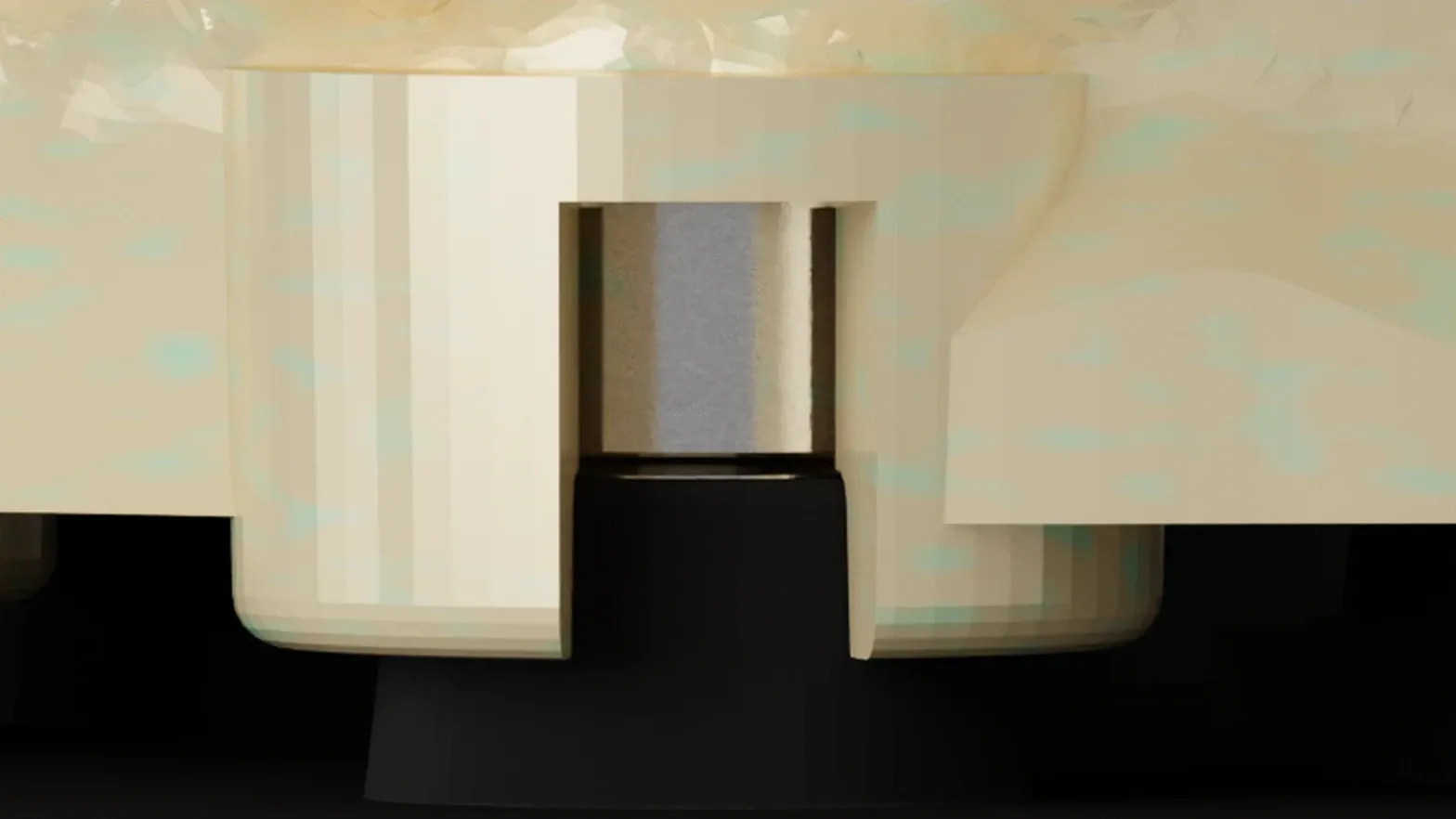
- A protected seating zone. Only the seating step around each magnet touches the plate. It stays free of supports, glue and sanding, because every support scar on a mating surface is material you didn’t design and can’t measure.
- A two-step blind seat. The magnet sits in a closed cavity, glued at the bottom.
- The peripheral lip. A shallow horizontal overhang rings each seat, thin enough that a DLP or LCD printer reproduces it cleanly without local supports.
- The stand-off rim. It lifts the seating geometry clear of the first layers.
- Three seat variants. The CAD library offers tight, standard and loose, for different printer and resin behaviour. You choose one once, with the fitting test, and use it everywhere.
The model prints flat: supports go under the base and never on the seating step. Flat is also where the anatomy of the teeth comes out best, and a lower build means fewer layers. The base geometry works for you, not against you.
The full geometry, seat by seat: ShieldBase™: Geometry Designed for 3D Printing.
Pillar 2: DockingMatrix™ Configuration
DockingMatrix™ is the modular magnet architecture that lets you mount implant cases the same way you mount single units.
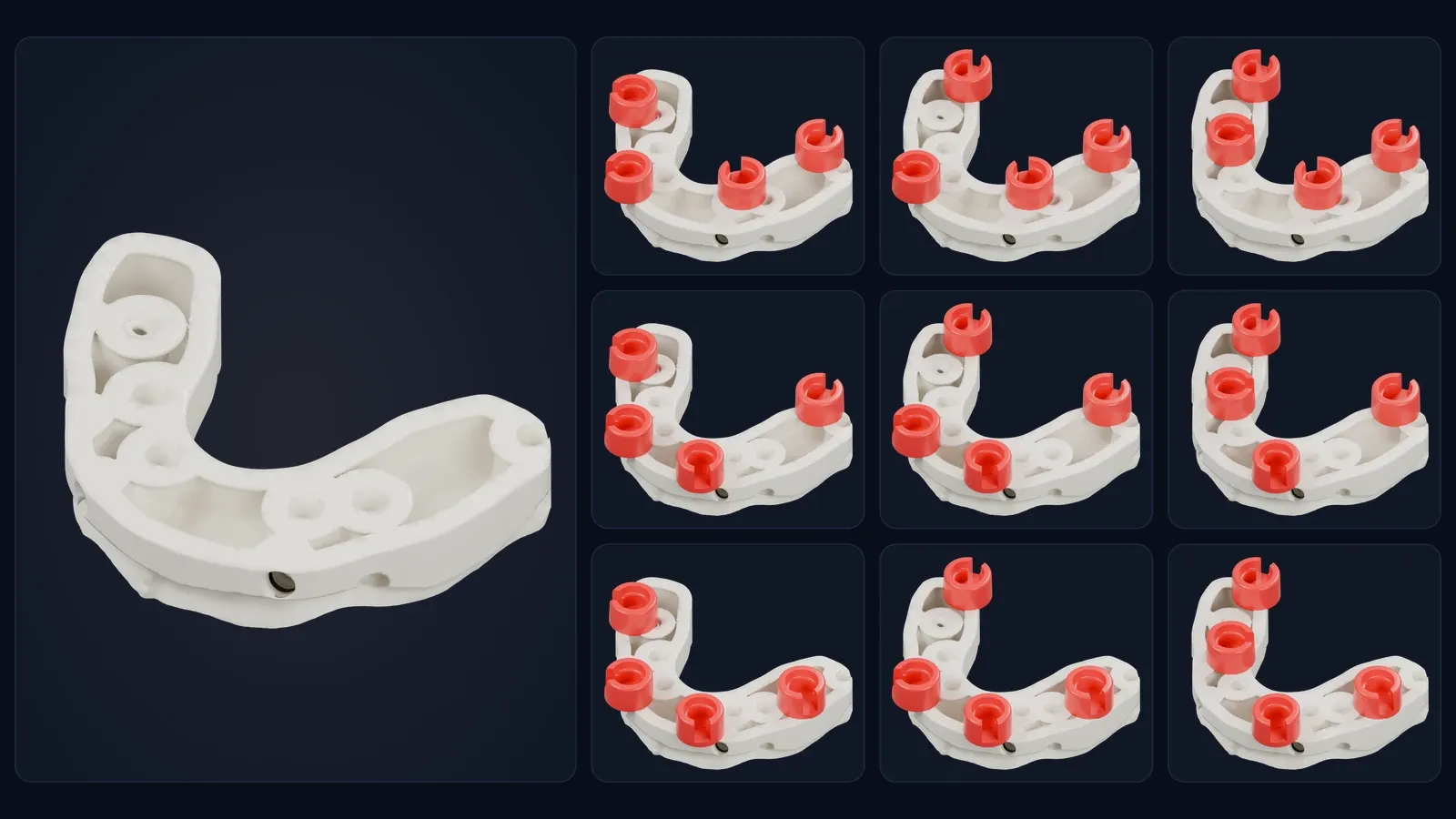
The DACOS Omni plate has eight magnet positions. Each printed model uses four attachments, in one of nine combinations. Without analogs you use the standard combination, DAC4-5. With implants, analogs or removable dies, you choose the combination whose sockets stay clear of them.
Fixed, oversized bases tend to intersect the analogs: the base becomes the problem, not the magnets. The compact ShieldBase™ footprint and nine layouts let you work around the analogs at the design step. The system adapts to the case, not the other way around.
The nine combinations explained: DockingMatrix™: 9 Combinations to Clear Your Implant Analogs. A real case from scan to verification: Full-Arch Implant Case on DACOS Omni: Complete Walkthrough.
Pillar 3: TrueZero™ Calibration
TrueZero™ is the physical reference of the system, and you print it yourself: once, in your lab, on your own printer.
That is the point. A calibrator printed on your printer, with your resin and your post-curing, carries the same systematic behaviour as the models you will print. The installation locks that behaviour into the articulator, and every model seats on it. A reference made somewhere else, by another process, cannot represent your models.
- Fitting test first. One small print carries the three offsets: Tight, Standard and Loose. You check which one seats on the plate, stays stable and does not rotate, then print the full calibrator in that offset. Standard is right for most printers and resins.
- One offset everywhere. The offset you chose is the same in the calibrator, the CAD attachment library and the plate library.
- Made like the models. Same printer, resin, layer thickness, exposure and post-curing as your production models. That is what makes the calibration valid.
- When your setup changes. A new resin with different behaviour means a new fitting test. A new printer means a new calibrator. If nothing changes, the same calibrator installs further plate sets.
More on the calibration: TrueZero™: Your Printer. Your Resin. Your Zero.
Pillar 4: Dedicated CAD libraries
ZeroDrift™ lives inside the workflow you already use. Dedicated libraries are available for exocad, 3Shape and Blender for Dental, with the nine combinations ready in the design environment.
You select the combination for your case, and a boolean merges the attachments into your model. No external tools, no manual geometry. The protocol becomes part of your CAD workflow, not something you do afterwards.
The promise you can check: the pin returns to zero
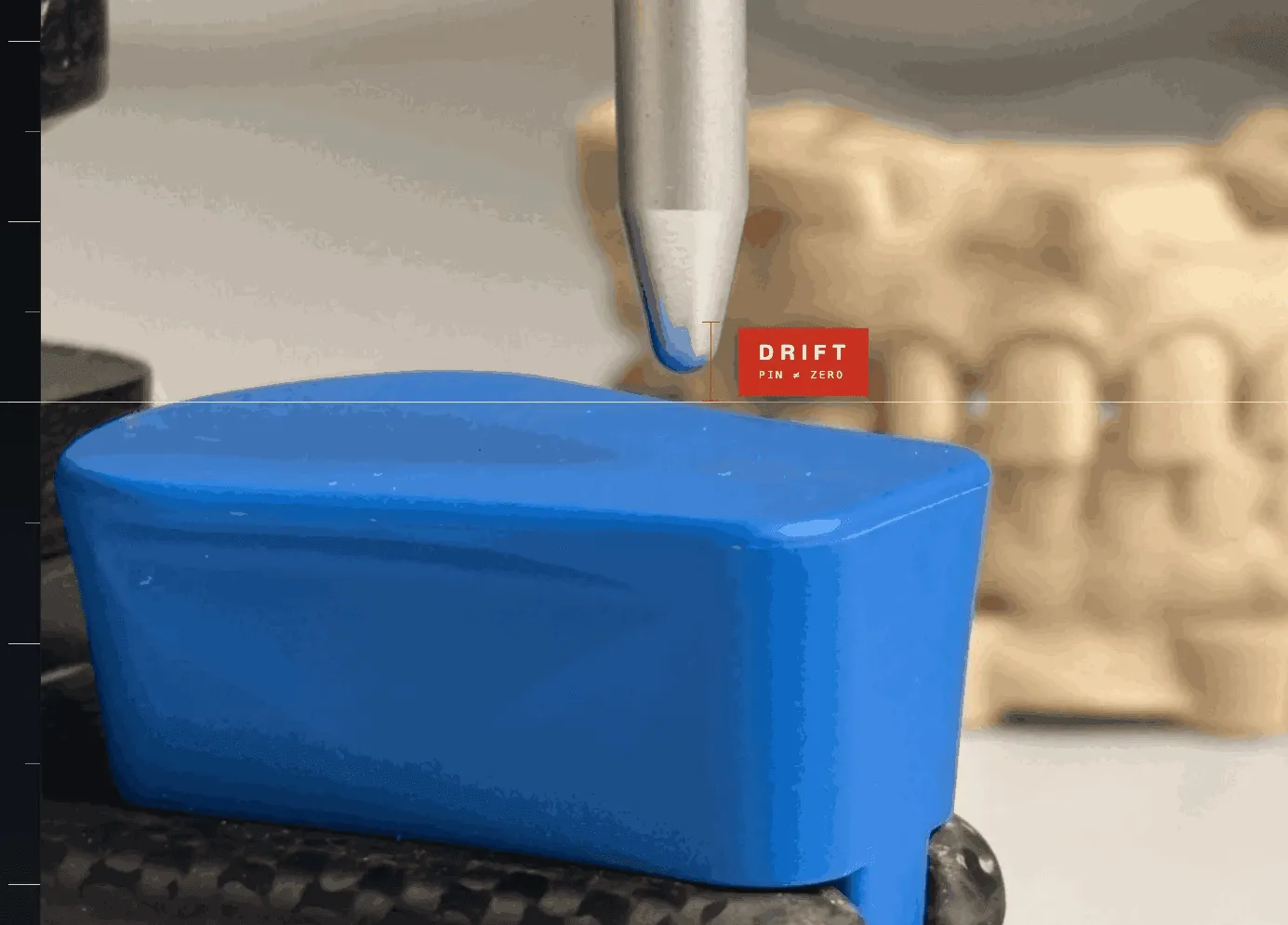
Calibrate with TrueZero™, design with ShieldBase™ geometry, mount with DockingMatrix™. Then remove the model, remount it and check again. The pin closes in the same place and the contacts match your CAD design.
We do not hand you a number on a datasheet. We hand you a check you run on your own bench.
What this means for your lab
Remounting in minutes instead of half an hour. Plaster mounting means mixing, setting, cleanup and verification. With ZeroDrift™ you print the model with ShieldBase™ geometry, select the DockingMatrix™ combination in CAD and mount magnetically.
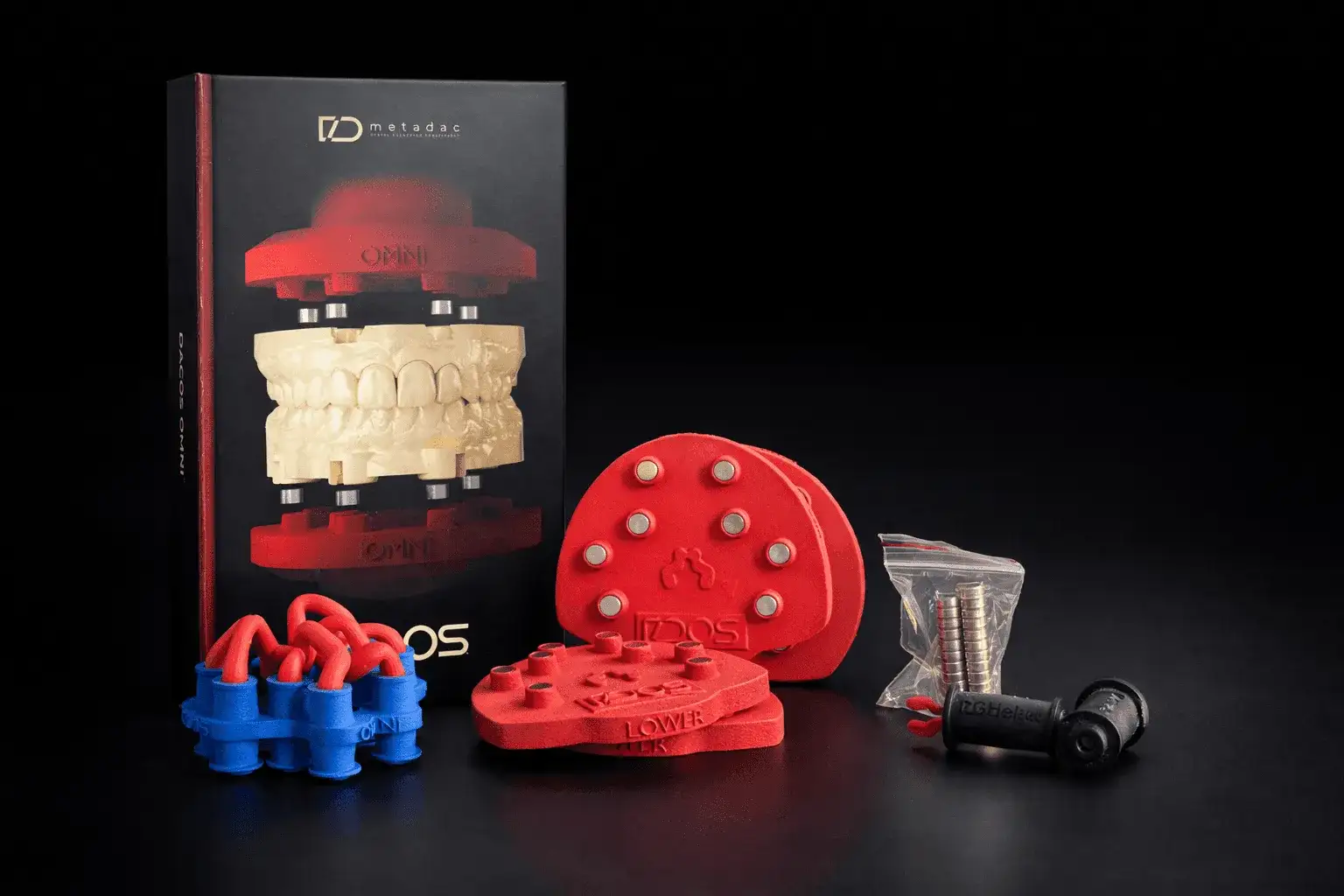
The articulator you already own. Direct plates fit Artex, ASA Dental and SAM articulators. Flex plates fit any articulator with a mounting plate. No new articulator to buy. Find your kit.
Room for implant analogs. With nine combinations you choose the layout that clears the analogs, instead of choosing between the analogs and the transfer. Full-arch implant cases, bridges with analogs, removable work: you pick the combination around the case.
Fewer bench adjustments. When the pin does not return to zero after a remount, you lose time troubleshooting. Is it the scan? The print? The articulator? The mount? If you followed the protocol, the transfer is no longer a suspect: the pin returns to zero and the contacts match your CAD design.
One less place to look
A full-arch case that comes back for wrong contacts costs time, materials and credibility. With ZeroDrift™ the transfer is off the list of suspects, so you look where the problem really is.
Patent pending
The DACOS Omni system is covered by a pending international patent application, and ShieldBase™ by a Hague design registration. It is not the magnets alone, the geometry alone or the calibration alone: the four pillars work together as one protocol, and copying one piece without the others does not reproduce the result.
From CAD to articulator
Digital dentistry promised control from scan to design to fabrication. The transfer from digital to analog is where that control is easiest to lose: silent drift, uncontrolled variables, compromises sold as convenience.
ZeroDrift™ Transfer closes that gap. ShieldBase™ Geometry is designed for the way a resin printer builds. DockingMatrix™ Configuration adapts the magnet layout to the case. TrueZero™ Calibration calibrates the plates to your own printer and resin. Dedicated CAD libraries bring the protocol into the tools you already use.
The result: the pin back to zero, remount after remount. Any articulator. Implant analogs cleared. The transfer is no longer a variable.
Read lab reviews · Find your kit
Patent Pending. The DACOS Omni system, including its adapter plates, calibration method, attachment geometry and magnet placement tools, is protected by a pending international patent application.